My story begins with two Chows, and ends with a third.
Emily, Old Town Bangsar South.
The inspiration for the content of this 900th post came from a teatime chat I had with Emily (Chow) the day I left for the SUSI reunion in Singapore, which took place over the April Fool's weekend.
She marvelled at the size (or lack thereof) of my 'luggage', which comprised the smallest backpack ever (that fantastic JP Morgan bag which has followed me on several memorable trips) and a laptop bag (the enduring East-West Center bag whose zip has just gone bust). Little did I know that I would be outdone by Chow (Geh Tsung) at the reunion, who carried what appeared to be half of what I had.
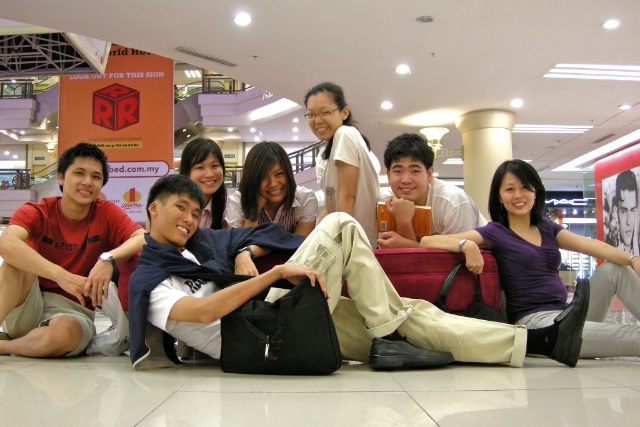
SUSI/USIE Malaysia, MacRitchie Reservoir, Singapore.
(Photo by kayak station staff.)
Chow (fourth from left) inspires me in many ways, but one that has left a lasting impression is his simplicity. I guess that also frees him up to enjoy life better and be more fully immersed in the moment.
I think it was a Ken Rockwell post that first got me thinking about the concept of simplicity (plus fragments from my d'NA days; I think there was a lot of discussion and input on simplicity, especially of the monastic sort, then). Click
here for that Rockwell post.
I guess 900 is a good point to distill what really matters, to share my thoughts on a few things close to my heart at this point in my life:
1. The environment
2. Photography
3. Life lessons learnt, and values going ahead
The year that has been since the 800th post, has been an extremely eventful one, filled with unexpected successes and experiences; things I never believed I could ever be a part of. These include going to the States on SUSI, winning the Royal Education Award, winning IGEM, successfully 'staging' Operation Resurrection, and getting more teaching jobs than I ever thought I would within a year of graduating.
Part of the cast and crew of Operation Resurrection,
Celebration dinner at Poco Homemade, Bangsar.
And then there were the trips. Between March and June, I travelled to six places on seven trips: The Dusun in Negeri Sembilan, twice to Singapore on SUSI-related stuff, Kelantan and the south of Thailand, Redang for SEATRU, Tasik Kenyir, and most recently, Bangkok and the surrounding region. I depart later today for my last trip this season: Kuching.
A preview of the posts and pictures to come:
The Dusun with Tim, Nasha and Mich.
Trip to Kota Bharu, Hat Yai and Songkhla with George.
SEATRU, with Jia Hui, Chern Zhong and Poh Fong.
BF graduation trip to Tasik Kenyir.
Mensa trip to Thailand by rail.
* * *
The Environment
I've always grown up liking nature, and though born and bred in the city--the capital, no less--I've always felt that I belong in the wild. My decision to take up Ecology in university was partly fuelled by this desire to see the natural world in Malaysia, to build on what began as a childhood hobby.
One of the things I never expected was the sudden mushrooming of the present-day environmental movement. Over the last three or four years, the word 'green' progressed gradually from being little more than the colour of the PAS flag, to its current status as the number one buzzword on everyone's lips, whether or not they give two shits about the environment.
In light of this, whenever people asked about what course I was doing and all, I would answer 'Ecology' first, and then whenever I received blank stares accompanied by, "Psychology? Biotechnology?" I would spare my inquisitors the pain and just translate my course as, "Environmental science". And because of the popularity of the word 'environment', those people would immediately think of me as some sort of activist, and go, "Ahhh.." as if they understood what ecology was about.
The more well-informed, of course, know what ecology is. And their replies would be along the lines of, "Oh that's really good, what you're doing; we need more people like you to save the world."
And therein lies the problem. I took up Ecology because I liked it, because I liked nature and plants and animals and natural landscapes. I'm not one of those recreational types who love hiking in forests for the sake of it; on the contrary the forests remind me of homework and assignment and (sometimes) interminable field trips. But I still love the natural world. And I did not take up Ecology in order to save the world or anything.
To me, environmentalism is not just about preserving nature, dealing with energy, population and waste issues. It’s about education and everyday decisions. It’s also about heritage. How did what we have, what we see, what we live in, come to be? Why are these things here? In Hawaii I was led to think about the Polynesians and early settlers; natives and aliens; builders and destroyers.
The practical question, and one which very few are actually considering, is, how do we develop a future-looking perspective that is also informed by the past? (Incidentally it was only while waiting with Nasha for the train from JB Sentral, that I rediscovered that Ramsay Taum mentioned this in his lecture early on in SUSI).
Ramsay shared a Hawaiian quote with us; "I ka wa ma mua, ka wa ma hope", which means, "The future is in the past".
And then, there is this whole dimension of Sustainable Development. To me, there are many sustainable ways to do unsustainable things. What exactly is sustainability anyway?
To this end, I am grateful for the SUSI experience. What I appreciated most was the time we spent in Hawai'i, both on O'ahu and the Big Island, in particular the instances when we could observe and experience first-hand the ways of life of some communities at the forefront of environmental action: not action as in activism, but action as in living out the very ideals the environmental movement is trying to achieve.
Looking through the pictures I prepared for the SUSI slideshow, the overarching theme seemed to be heritage: from the Hawaiian customs, to the buildings and the spaces built by communities past, etc. How are we stewards not just of these gifts, but of the gift of earth itself? How do we appreciate, or else not appreciate, what we have?
Maybe it is because of this, and because of what I see happening to Brickfields (thanks, Poh Wah, for organizing that walk), that I started the Mensa Heritage SIG. And I owe it, in no small part, to my VI days, this awareness of, and interest in, the significance of heritage.
There will be more to write on this subject, but I mention it here because it is one of many ongoing trains of thought in my mind. Although it was my lifelong dream, I opted out of medicine because it seemed a bit saturated; too many friends were doing it. When I chose Ecology, it was practically unheard of by the masses (and it still is, to a certain extent), but the overall worldwide emphasis on 'green' in recent times is turning me off somewhat.
The thing is, I want to continue studying, and the path to a higher degree in Ecology has been all but paved for me. But is it what I really want? And even if it is not what I really want, is it the area in and through which I can make the biggest contribution to society and the world?
* * *
Photography
There is a reason why I am not, in spite of my enduring interest in photography, a professional photographer: I am too much my own person to do things like food, furniture and wedding photography.
It's like when people say, "Ben, you like writing. Why not become a journalist?" Creative writing for fun, and journalistic writing for magazines and newspapers, are quite polar opposites, I should think. The former allows you free rein over your subject matter, content and style, while the latter almost always involves censorship and heavy editing at some point or other.
My thoughts on commercial photography are based on some actual experiences (i.e., jobs) I've had over the last few months. And I am convinced that there is a big difference between the usage of the camera as a 'tool of the trade' and as an artistic device.
With Mustapha Kamal, Experimental Theatre, UM.
(Photo by Tim.)
I was pleasantly surprised to discover that Mustapha Kamal, the architect of the present Experimental Theatre is, like the architect of the Dewan Tunku Canselor complex (the late Dato' Kington Loo), a VI boy. It was only when I met him again at the VIOBA Dinner, that I learnt of this.
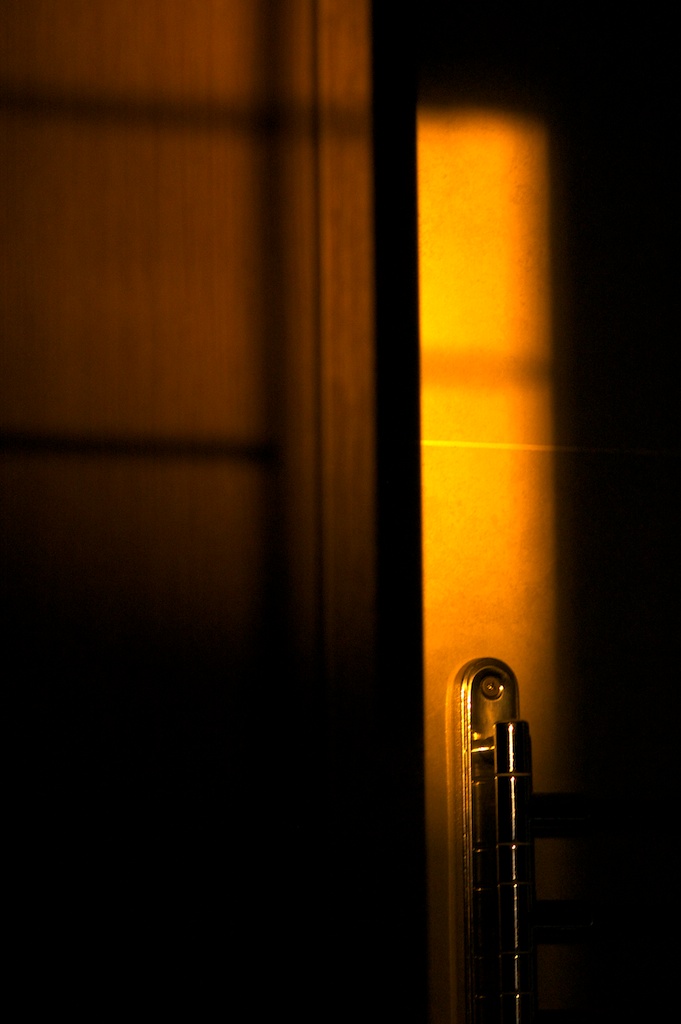
We interviewed him for the Operation Resurrection project (an interview I have yet to transcribe, and which is long overdue). Little did I know that a passing remark he made, would leave a lasting impression on me. When we told him we used film for a number of the photographs, he asked if we used those old mechanical cameras. And I said yes, because we did in fact use a mechanical camera, the FM10, for the colour film pictures (including the ones of Fit in the doorway and Yen at the dressing table, below).
'Doorway, North Wing'
Experimental Theatre, UM. Fujichrome Velvia.
'The Dressing Room'
Experimental Theatre, UM. Fujichrome Velvia.
The trip to The Dusun happened a few weeks after the interview with Mustapha Kamal. It so happened that that weekend coincided with Earth Hour, and so I thought it would be a good opportunity to leave all electronic gadgets (save the mobile phone) behind. I thought it would be interesting to sweep the dust off the FM10 and chance the exposures (the meter was somewhat faulty, although it miraculously got better by the next trip, and seems alright now), using negative film.
I've come to the realization that I really like negative film. While slide films look better if you get it right, they are a lot less tolerant of low light, being slow films, and have a relatively poor exposure latitude. Negative films are also cheaper and easier to process; the C-41 chemistry is still available at a number of small-time photo labs, while E-6 is, as far as I know, only available at E-Six in Pudu Plaza and Photo Media, SS2. It also helps that there are really impressive negative films out there like the Kodak Portra family.
Anyway, the long and the short of it is that I've been bringing the FM10 (and the 28mm AI and 105mm AI-s lenses) on a number of my recent trips, and will be bringing it to Sarawak. It has been a liberating experience, using the manual camera again, and while the N80 is still a fantastic film workhorse with second-to-none handling, the FM10 is a very pleasant holiday/trip camera.
One of the most startling revelations of late was Fujifilm's announcement, a few months ago, that it would be discontinuing its Astia slide film, leaving only Velvia and Provia in the professional line, and the consumer Sensia.
I found out when I tried to order a few more packs of Astia via B&H, only to find that it was no longer listed. The only Astia I ever shot, before last year, were the few rolls that Kelvin Chan gave me; I never saw Astia on the shelves here, neither in E-Six, nor in Keat's. And then when I went to the States I purchased 10 rolls, about half of which I shot on SUSI. Later in the year, I ordered another 5-roll pack; now it would seem that these 15 rolls are all I will ever get to shoot.
There are six left, and the last roll I shot (i.e., the 9th) was on the Kelantan/Thailand trip with George. I shall dedicate an upcoming post to Astia, my favourite slide film by far. But for now, here's a sampling of the pictures I took on Astia, in the south of Thailand.
Border crossing, Sungai Golok.
Muslim man, Sungai Kolok train station.
George, train to Hat Yai.
Catholic church, Thanon Thamnoonvithi, Hat Yai.
Four days ago, I finally met the illustrious VI photographer, Chan Bing Fai (picture below, second from left).
Mr Chung (third from left), who is now back in Vancouver, had a lunch appointment with Mr Chan, Mr Vincent Voo (first from left) and one Mr Saw, who was a senior assistant in the school in the early post-Merdeka days. They very graciously invited me, this little boy so many decades removed from them, to join in their luncheon.
It was at Hanazen, Jaya One, and incidentally we bumped into Datuk Mahadev Shankar (fourth from left), who was Mr Chan's ex-classmate.
If I remember correctly, Chan Bing Fai was the first Malaysian photographer to be awarded a Fellowship in the Royal Photographic Society, UK. Mr Chung was singing my praises, and I must admit it was somewhat intimidating to sit next to this great while he was going through the photographs I had brought along to show (selected 8R prints and mounts, plus slides from SUSI).
I'm looking forward to meeting him again to catch up and talk at length about photography. I believe there is so much to learn from the 'old guard'--people like him and Eric Peris who have so many
decades of experience to share with the new generation. Photography then was arguably different from photography today, but some principles I believe ought never to be forgotten, and these are not principles you can learn from today's books and photographers, who are much younger than these living legends.
In early April, Nasha and I attended the opening of the
3 Young Contemporaries exhibition at the Valentine Willie Fine Art Gallery in Bangsar Baru a.k.a. Telawiville.
It was Alissa who told me about it. Curated by her supervisor, David Teh (third from right), it featured works by three contemporary Thai photographers; Arin Rungjang (second from right), Kornkrit Jianpinidnan (first from right) and Pratchaya Printhong (absent).
The talk/dialogue at the launch was quite inspiring. I appreciated most of all the insights into photographic philosophy as expressed by the Thai artists; the discourse covered, among other things, photographic logic and the unfairness of life. I jotted most of the dialogue down on a piece of paper.
One question in particular, during the dialogue, stood out among the others. A member of the audience, Erna, asked about defending ‘simple’ pictures, such as shots of everyday furniture, which some viewers disparage as "something even I can shoot". And that's a legitimate question, because a lot of these 'art photographers' often shoot mundane subjects. I see a lot more 'wow factor' in shots taken by some wedding/portrait photographers.
But then, like Alissa says, for these art photographers, a lot of the art lies in how the photograph was made, and the circumstances in which the photograph was taken. There is a lot more context to their work, and it's not always merely about aesthetics that pop.
I think, if you attempt to shoot merely for the aesthetic aspect of it, you would run out of steam after a while. I cannot help feeling that people like Eric Peris and Chan Bing Fai need a much more solid driving force than merely 'pretty pictures' to keep them going all these years. Photography becomes something of a discipline, an exploration of the world, which, now and then, yields truly spectacular results, but which must, like any other discipline, be undertaken with patience and perseverance especially in seasons of photographic 'drought'.
With Eric Chan.
(Photo by Tim.)
Eric's last big job from his Puncak Bukit Jalil base, was preparing the prints for Operation Resurrection. I owe it to Doulos for discovering this amazing photographer, and to Eric himself for guiding and encouraging me in developing (no pun intended!) my photographic technique, especially in black-and-white.
When I told Mich that Eric had shut down shop, her first reaction was, "Eric really quit dy? Not even taking pics issit?"
My answer was probably truer than I knew it to be: "Still taking pics. Photographers may quit their services like printing and all, but they never really quit taking pics. At least, the real ones, the great ones, never do."
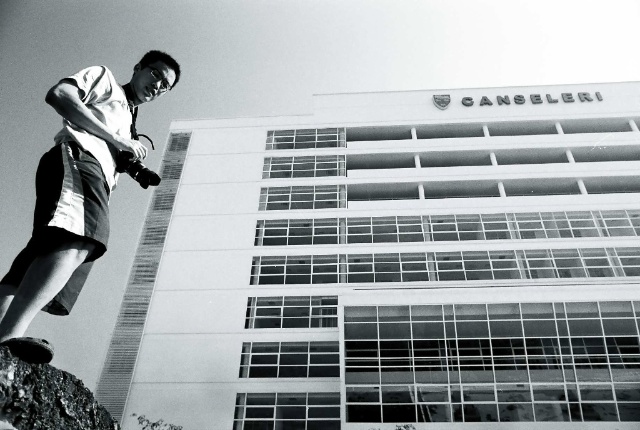
Tim and the new Chancellery. T-Max 100.
And the experiments haven't ceased! This roll of film was developed in 'caffenol' (quite a lot of information online; for a good intro try
this link), a combination of vitamin C and coffee, an everyday alternative to more expensive film chemicals. The best part is that it actually works, albeit with much longer development times.
One of my ongoing reads is Geoff Dyer's book,
The Ongoing Moment, an extended essay on photography, in particular its development in America in the first half of the 20th century. There is no doubt in my mind that, in the last few years, I’ve really built up my technique, but as I expressed to Yen, there is now a need to put some muscle into themes, subject matter, etc; to narrow the scope, and deepen the art, of my photography.
In a way this has brought me back to thinking about my photographic roots. I owe it to Tsu Wern for asking me shortly after the Kenyir trip, "Why photography?"
My reply was somewhat lengthy, and perhaps I will share all of it in an upcoming post, but this was the opening of my reply:
It seems that these days, it is nearly impossible for people not to associate me with my camera and/or photography. But it wasn't always the case. I only started taking photos in Form 5; before that I took watercolour painting classes from Form 1 to Form 5.
My foray into photography began as an attempt to record things that happened in class; and it started with a really simple point-and-shoot film camera. I took pictures of classmates, of lab sessions, of crazy things VI fifth formers do (including 'fly' school by jumping over the wall) and so on. I brought this same camera to NS and shot 20-something rolls of film there (if I remember correctly). Then I got the digital camera, which I used throughout our Form 6 days.
* * *
Values
So what have I learnt since post number 800? What are some of the most important life lessons I would do well never to forget?
1. It
always pays to wake early.
Nowhere was this more true than that morning when Sai Dong and I decided to rise early and go hiking with John Cusick and Sandy the Labrador, on the hills near the University of Hawai'i, Manoa. It was our last day in Hawai'i, and while the rest of the company were fast asleep after last night's dinner at the Thai restaurant, Sabai Dee, we were up and viewing Honolulu from a radically different point of view.
2. It’s not worth fighting and being sour.
Nasha at Muse, Jaya One.
One of the most unpleasant experiences of the past year was the argument, and subsequent cold period, with Nasha in the States. Deep inside I hoped and prayed that we would be able to talk again, never quite expecting that we'd become such good friends in the months ahead. In Nasha's own words, "Life is too short to be angry at each other."
3. Romans 5.
Suffering produces endurance; endurance, character; character, hope; and hope does not put us to shame.
4. Never stop, never quit.
In a sermon, Pastor Sunita said, "Discouragement is to stop moving, to quit."
I ended my Convocation speech with the Martin Luther King Jr quote; "If you can't fly, run; if you can't run, walk; if you can't walk, crawl; but by all means, keep moving.” And it seemed to leave enough of an impression on the Chancellor, Sultan Azlan Shah of Perak, for him to quote it back to me at the post-ceremony reception.
One of the most heartwarming movies I watched in the previous year was
Crazy Heart, which won Jeff Bridges his first Oscar in five nominations over four decades. At the turning point in the movie, Robert Duvall's character tells Bad Blake (Jeff Bridges) that it's never too late to try again. And I think that's true of Jeff Bridges, how he's been at it all these years without giving up.
It's like that line in the epic Seabiscuit (another movie starring Bridges); "You don't throw a life away just because it's a little banged up."
I continue to be driven by the realisation U2 had after the PopMart tour, before their incredible comeback with
All That You Can’t Leave Behind, which Bono summed up like this; "Deep down inside we weren’t as shallow as we’d like."
* * *
This story ends, as I said it would, with another Chow: Samantha Chow, of Mensa.
What can I say, this incredible young woman, barely 21 and already on the verge of taking over the world in her own way.
Samantha at the Rama VIII Bridge, Bangkok.
When she shared her thoughts on turning 21 soon, and the responsibilities that will come with it, I realised that I probably only turned '21' on my 23rd birthday; almost as if time stood still for a couple of years in University. Or maybe it was Form Six; you grow up, but you take your time doing so.
Celebrating both Mother's and Father's Day this year at Ben's (where else?) in KLCC, it felt like celebrating them for the first time in a long time. I think the world changes when you begin to learn what it is like to occupy your parents' shoes; perhaps the best gift a son can give his father, is to be a good father to his own son.
And nowhere does this hit home more clearly than when I see Dad with Ah Kong, when I ask myself what sort of father I will be to my own children when the time comes; will I honour my own father and grandfathers in the way I conduct myself as a father (and, God willing) a grandfather?
Perhaps the deepest-driving lesson from the past year, was one which manifested itself graphically as the train rattled into, and then out of, the Taiping station on our way to Butterworth a couple of weeks ago.
The station itself is under renovation, undergoing what I can only imagine must be a relatively massive transformation into something along the lines of the modern-ish stations of southern Perak. This means that the photos I managed to get of it, during the d'NA trip in 2009, and on the way to Penang from Ipoh last September, above, are the first and last I'll have of one of Malaysia's very earliest train stations, pre-renovation.
I do not bemoan the loss of the 'old look'; certainly things change and with renovations come many much-needed upgrades. I do, however, celebrate the beauty and character of the Taiping station--this most historical of Malaysia's railway stations.
And the lesson is this: whatever the future may bring, the best parts of the past go with you.
I like what Bono said when he introduced 'Miracle Drug' at the Chicago 2005 concert:
We don't really look back in our music, we don't look at the past. The best bits of the past we try to bring with us. There are songs, songs like 'Pride (In the Name of Love)', songs like 'Sunday Bloody Sunday', songs like 'Where the Streets Have No Name'. They're the best bits of the past and we'll take them with us. 'Cause we're interested, we're excited, we have faith in the future. That's where we're headed.
The best bits of the past we'll take with us.
Pastor Augustin prays for the Kits, Bangsar Lutheran Church.
Saying goodbye to Sivin and the Kits was something of a coming-of-age experience, I think not only for myself, but for The Father's House, the community Sivin spent the last decade building and nurturing. It reminds me of what St Paul wrote; that he may have planted the seed and Apollos may have watered it, but only God causes growth.
A reminder that churches do not survive, let alone thrive, on the power of man (or the power of a man), but by the grace and power of Almighty God. But then God works through the hands and feet and minds and mouths of men and women, and in a sense saying goodbye to Sivin was an ironic reminder of the bittersweet verse he so aptly chose as the 'motto' of the Bangsar Lutheran Church:
"As the Father has sent me, I send you." - John 20:21.
It never really made sense to me when I first heard it, a teenage boy of 16 then. Over the years its meaning would slowly sink in; the height of the command, the depth of the promise, the sadness of knowing it was one of the many ways Jesus would say goodbye. I cannot help but feel that the disciples of Jesus must have carried these words of his, truly to the very ends of the earth.
Pastor Augustin Muthusami is quite different from Sivin, but I suspect we trust him, not so much because he's one of many Lutheran ministers ordained by God (perhaps if we had more faith we would trust on such grounds)--but I suspect we trust him because Sivin entrusted us to him. It's one thing when the church appoints any other someone to replace your outgoing pastor; it's another when that replacement is your outgoing pastor's best friend.
I like what Pastor Augustin said at the Genting retreat when I asked him which was his favourite Star Wars character. "Darth Vader. Here was someone dressed entirely in black, and there was no doubt that he was evil. And he could go to council meetings and if he didn't like anyone he could strangle them." That sure took us aback; and for a moment we wondered if it was a thinly veiled message for the BLC council!
But the 'Darth Vader' pastor of BLC has been doing, in my opinion, a great job so far of steering the church into the next phase of its existence.
Ben and Li-Shia, VIOBA Dinner at the Royale Chulan.
(Photo, I think, by Azim.)
Going to the VIOBA Dinner with her, it really felt like the last four years did not happen.
The people we met, the questions we fielded, the smiles we so kindly and politely returned.
You see, if it were any other community, I wouldn't have thought twice about that night. But these are Victorians, who are living and breathing and laughing and partying many decades long after they have had any right to; people like Mr Chung who are not content just sitting down and waiting for life to pass him by.
They make me wonder about where and what I want to be many years hence. And so I cannot evade Praba's prompt, "Big picture, Ben. Think about what you want. 30 ringgit? Is that what you want?"
And I cannot think about the future while simultaneously ignoring the past. Ramsay Taum, "The future is in the past." There are some things, I think, we really cannot leave behind.
It is 2.00 a.m. now, on Sunday, and I just woke up from a three-hour nap, unfortunately missing
Gran Torino. But in that dream I was at the ISKL, and I won the Extemp Gold again, and Zer Ken (I think) won the OO Gold. What an unusual dream.
The VI has been on my mind in so many ways, from the dinner to the Kenyir trip, from returning on the day of the Indian High Commission's Rabindranath Tagore celebrations, to the day out with Mr Chung and company, meeting Chan Bing Fai, Vincent Voo and M. Shanmughalingam.
In less than 11 hours I will be on my way to the other side of the country with this girl. How much has indeed changed over the years? Sometimes I feel, so much, and also so little. I am looking forward to the trip, but also loathing it; and yet, after all these years what is enjoyment and what is dread? What is sorrow and what is joy? Who are those people you're not interested in talking to, and yet talk to anyway?
I remember that late night--or was it an early morning?--when I shared with Mum. And she said, "I know exactly what you mean." And her answer, "Aunty Siew Khim."
Perhaps my recent exchange with SooT over email can best be summarised: the unchanging faces amidst the faces of change.
d'NAers, Robot Sushi, One Utama.
d'NAers, Oval, One Utama.
Coming to eight years, strength to strength. Praise be to He who brought us together in the first place.
Bumping into Bei Shan at the junction of Rama IV and Surawong might have been a most uncanny coincidence, so much so that, I realised that very moment C.S. Lewis was right: a few minutes' difference, a walk taken or else not taken, is all it takes to prevent or permit two people from meeting for the first time, for ever.
* * *
Epilogue
Two significant things happened yesterday: the first was the Bersih 2.0 rally, which Yen and I followed with more than the usual degree of interest. The second was my pleasant surprise at the articles on local trains in The Star.
The articles can be found, albeit with fewer pictures than appeared in print, at the following links:
1.
End of the Line
2.
Trainspotting in the Klang Valley
Undoubtedly it was the recent termination of the Tanjong Pagar station in Singapore that has generated all this railway-related buzz. A generation is coming that may never know what rail (real!) travel is, with the advent of somewhat more convenient, and faster, air travel. I'm glad to have been born somewhere in between, and to have actually experienced taking the train from the Old Railway Station in KL, instead of from KL Sentral.
Sultan Ibrahim of Johor on why he drove the last train out of Tanjong Pagar,
here.
And then I wondered if I might be able to link the two for an epilogue of sorts to this post.
Family on Raya eve, Taiping station.
This photograph was taken at the Taiping station last year,
en route to Penang from Ipoh. I think it was the very eve of Raya, and I can only imagine the understated excitement that must have been bubbling in this family who had just endured the longish journey home.
I don't know if I realised it then, but I like how the Malaysian flag features in this picture. And I like how its colours are intact in spite of how Ektar practically jazzed everything else in the odd (I think) sulphur lamplight of the station.
Ekspres Rakyat crossing Tasik Bukit Merah.
This was taken on the journey from Penang, back to KL. It was, in some ways, my take on an Eric Peris classic, 'The
Ekspres Rakyat crosses Tasik Bukit Merah'. Indeed Ruth and I were on the
Ekspres Rakyat (Citizen's/People's Express) that morning, and I was shooting the scene from within the very train Peris shot from a position in between the tracks and the lake.
In his photograph, the train is but a blip in the distance, a somewhat static presence slowly but surely entering an otherwise serene scene. In mine, the train is a roaring vessel, speeding across the lake; and you can see this speed in the blurred grass (thanks, in part, to Velvia 50, which necessitated a slower shutter speed than I might have liked to use).
[Oh no.. 'speed' and 'grass' in the same sentence. No reference to non-photographic substances!]
Remember that old Curtis Mayfield song, 'People Get Ready'?
People get ready, there's a train a-comin'
You don't need no baggage, just to get on board
All you need is faith to hear the diesel's hummin'
You don't need no ticket, you just thank the Lord.
I wonder why he chose the train as a metaphor for social change. Maybe it's the momentum of trains, something relatively unstoppable. Or maybe it's how trains are such powerful equalisers, where everyone is a fellow passenger, a traveller on the same road.
Bersih and the People's Express, the trains that unite us in spite of all our differences. This relic of colonial Malaysia that has become so much a part of our fabric; the people of all walks of life who board the same trains to the same destinations, who travel the same routes in the truest spirit of the 'one Malaysia'.
This is Malaysia. This is my country.
This is who I am.