Thursday, December 09, 2010

Ektar 100 Preview

Film is dying, and yet film giants Fujifilm and Kodak have in recent years, well into the digital age, launched new and reintroduced film stocks.

Fujifilm re-engineered their classic Velvia (1990-2005) using an up-to-date film base, and re-released it in 2007 as Velvia 50 due to popular demand. Digital could not, and still cannot, come close to approximating Velvia.

Kodak's latest product (besides Portra 400, which is more of a revision and update than a new film stock proper) is Ektar 100, launched in September 2008. The original Ektar was introduced in 1989 with ISO ratings of 25, 125 (later 100) and 1000, and then discontinued in 1994. The new emulsion, while bearing the name of its predecessor, was not designed to be a perfect copy as Velvia 50 was.

Ektar 100 is touted to be, among other things, exceptional for scanning and digitising. It is also claimed to have the highest saturation of any Kodak print film available today, as well as the smoothest and finest grain, making it suitable for enlarging. (More from Kodak here.)

I got my first five rolls from B&H, collecting them from the UPS facility in Honolulu the day before leaving for the Big Island. It was the first film I shot on the Big Island, and to date I have finished some seven or eight rolls.


* * *


Of course, all the promotional fluff is meaningless if the film does not perform well as a film to begin with; there is no point hanging a wonderful enlargement of a lousy photograph. And as far as films are concerned, the main areas of concern are colour reproduction, performance under various lighting conditions and dynamic range.

It was the 69th anniversary of the Pearl Harbor bombing two days ago, and what better way to commemorate the occasion than to show how Ektar performed on the U.S.S. Missouri in Pearl Harbor itself!


Stars and Stripes.


The Captain's Cabin.


View of the U.S.S. Arizona Memorial, Pearl Harbor and Honolulu from atop the U.S.S. Missouri.


Piao, Ben, Nasha, Tawin and Renzo. Photo by the U.S.S. Missouri crew guy.


Site of a kamikaze attack on deck.


The ship's library.


In the shots above, Ektar performs relatively well in daylight; but so do most print films. Instead, I was impressed by the pictures of the Captain's Cabin and the Library. The warm light inside the Captain's Cabin was well-balanced with the cooler early afternoon light on the outside, maintaining white balance in spite of different colour temperatures.

In the Library picture, the red chair cushions, yellow signboard and brown index card cabinet were reproduced with good saturation and colour fidelity in spite of the fluorescent lighting.


* * *


Let's see how Ektar 100 performs under a variety of lighting conditions.

What follows are pairs of photos taken in fluorescent, overcast, shade and sulfur lamp light, respectively.


Maria Ivanova, Woodrow Wilson Center, Washington, D.C.


Lunch, Woodrow Wilson Center, Washington, D.C.

As can be seen, Ektar 100 handles fluorescent, especially warm fluorescent, light very well. Colours are vivid and true-to-life, and the textures are pleasant. In fact, the room looks more pleasant and welcoming than I actually remember it!


Lalang, Pologround at Taman Sultan Azlan Shah, Ipoh.


Joy, Pologround at Taman Sultan Azlan Shah, Ipoh.

Under overcast conditions, the overall image is less flattering, but colours remain punchy and saturated. The lalang, for instance, was practically drab and colourless when I shot it.


Suit Lin, Physics Lab at the abandoned school, Ipoh.


Greens, Pahala Plantations manager's house, Ka'u, Big Island of Hawai'i.

Ektar 100 seems to perform best in shade on warm days, where the light is warm enough to allow the saturated colours to come through without looking unnatural. Suit Lin's turquoise tank top contrasts with the orange doors, and the salad looks tempting!


Family on Hari Raya Eve, Taiping Railway Station.


Adrian, Ruth, Emily Chow and George, Ferry to Penang.

I once thought these atrocities were weaknesses owned only by slide films. Apparently not! Sulphur lamps seem to produce light which is too cool and 'green' for Ektar 100 to manage. Of course, this can be remedied using photo-editing software, but the process is laborious.


* * *


Let's see how Ektar 100 stacks up against Portra 160VC (which I recently blogged, and raved, about) and digital capture.


Ektar 100.


Portra 160VC.


Digital, Nikon D50.


Of the three, Ektar's colours are the least lifelike, while digital is the warmest. However, I like the textures of Portra best. Ektar has once again been trumped by the green sulphur lamps high up on the roof of the station, while digital has taken on a somewhat yellowish tint.

On the other hand, Portra most closely resembles what I saw on the platform, albeit a little less warm.


* * *


Roger and Frances describe Ektar 100 here as follows:

It's incredibly rewarding if you use it properly, and quite close to a disaster if you don't. Think of it as a negative film with the latitude of slide film, and it's rewarding: depending on exposure, you can choose anything from soft, pastel colours (minimum exposure) to rich, saturated colours.

That Ektar 100 behaves as a print film with slide-like qualities does not come as a surprise, as slide films Velvia and Provia are also abysmal performers under sulphur lamps.

It seems the one thing consistent about colour films, especially colour slide films, is that they require careful lighting. They are not as flexible as digital. But when you get the light right, they perform very well. Take Velvia; it has a very narrow dynamic range, extremely high saturation, and won't perform well in any but the finest light.

You see, it's difficult to get conditions right for films like Velvia, but when those conditions are right, no other film, and certainly no digital processor, comes close to matching it.


I've barely shot enough to arrive at the final word on Ektar 100; it seems to be the sort of film that can be suited to a variety of applications if the photographer knows what he/she is doing. And so I shall experiment a little more with it and see if I can get it to surprise me even further.

Langkawi, here we come!

Thursday, December 02, 2010

A little colour in a bland day

It's been one of those days.

The disappointment after driving through the morning jam. (Nonetheless, it was still the Eucharist.)

The (uncalled for) anger and short-temperedness.

Walking out at lunch.

Deciding to forego something I had looked forward to over the last few days.

(I did enjoy the morning, though. Playing 'Jerusalem' on the piano, sorting out those old books and remembering where it all began.)


* * *


I called it the 'max-confusion' point. It's not really a breaking point, but it's a point where everything is just swirling around too fast and too wildly for any of it to make any sense.


Yet in the midst of all this...


A very kind and thoughtful gesture. It was given as a lunch gift; I am about to have it for dinner.

And then when I got home, I saw this:


Shipped much faster and much more efficiently than it did to Hawai'i back in late May.


Film really never fails.

It never fails photographically, and it never fails to brighten up a gloomy day.

Friday, November 26, 2010

Love Renewed

Love never dies; it lives on
And on, in other forms--
Transfigured, as night to dawn
Away from expectation and norms;
Love changes and is changed
As riverbed gives way to water's plying hands
Into order as are stars arranged,
River missing from the earth, from clouds returning
As rain upon the land.


(7.00 p.m., 25 Nov at PJ Hills.)

Thursday, November 25, 2010

Twelve for Pleasantly Pastelly Portrait-Perfect PORTRA

Ever since starting out with film in late 2007, I have focused primarily on black-and-white and slide film. Print/negative film, on the other hand, has been a different story.

While it can be argued that the results of slide and BW film cannot be replicated digitally, it would appear that print film (the sort we grew up with) cannot rival digital. Locally, there are not many professional print films on the market (besides some like Fuji Reala, a roll of which I shot last year in Sungai Pisang here), and we have to make do with commercial films like Kodak Ultramax 400, Kodak Gold 200 and Fuji X-tra 400.

When I went to the States, I did not bring my D50 with me simply because I wanted to limit my shots, lessen the burden on my hard disk, and also bring back photos which would potentially have better survival value than JPEG files. I opted for much consumer film because slide film was expensive, hard to find and tricky to expose. But in between I shot a number of rolls of the well-known Kodak Portra 160 (not available in Malaysia, so I was quite excited when I placed the order prior to leaving for the States) and the new, but promising, Kodak Ektar 100.

I returned with extra rolls of each in tow, and having shot quite a bit of Portra now in some six different places/circumstances, I am convinced of its near-flawless versatality and can see why it has been an enduring favourite. What follows are twelve Portra pictures which, I hope, demonstrate this unique quality.


* * *


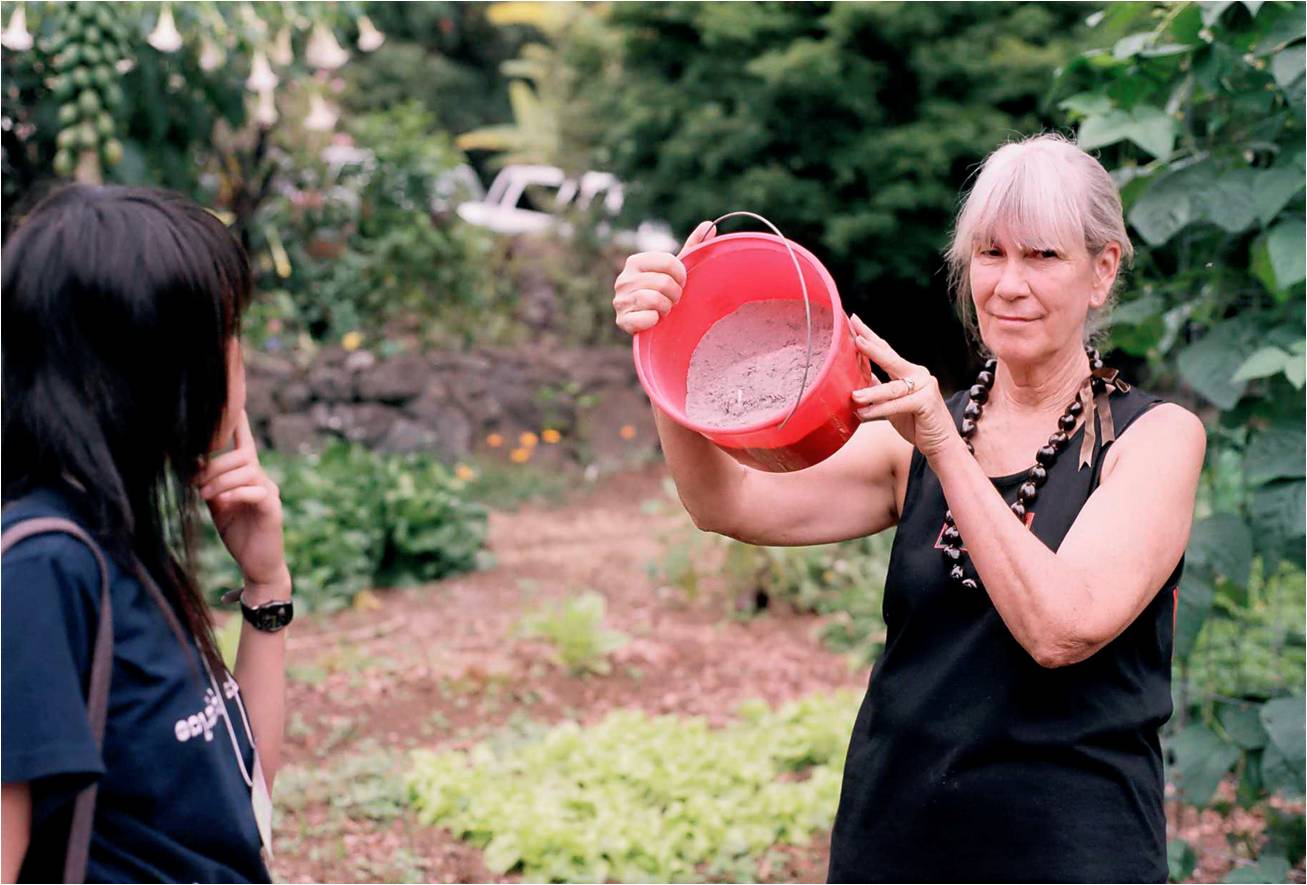
One: Nancy Redfeather, Kawanui Farm, Hawai'i.
Nancy Redfeather shows us her home-made fertiliser (I think this was a calcium fertiliser derived from bones) while Kant Kaw looks on.

I like how the film has rendered good skin tones, while keeping the pail and plants sufficiently red and green, respectively. Velvia would have brilliantly saturated the pail and the greens, but also given Redfeather's skin a nice, red roasting.


Two: Kitchen door, Kawanui Farm, Hawai'i.
A sidelit shot of slippers, shoes and sandals outside the Redfeathers' home.

A simple, straightforward shot, but I like the nuanced earth tones and beautiful dynamic range; shadows not too dark, and highlights not burnt out. Digital would suffer with the former, while slide film would fall short at the latter.


Three: ‘Ōhi‘a tree, Volcanoes National Park, Hawai'i.

This was taken near the Jaggar Museum, on the side facing Mauna Loa, the highest mountain on earth by base elevation. It can be seen in the background, behind land cleared for cattle ranching, a threat to forests in Hawai'i.

While the obvious choice for landscapes is slide film, especially stock like Velvia, I like the pastel colours here: the gentle, dreamy sky and the soft earth tones - all this while keeping the saturation brilliantly high on the red O'hia flowers. I can only imagine Astia doing this better.


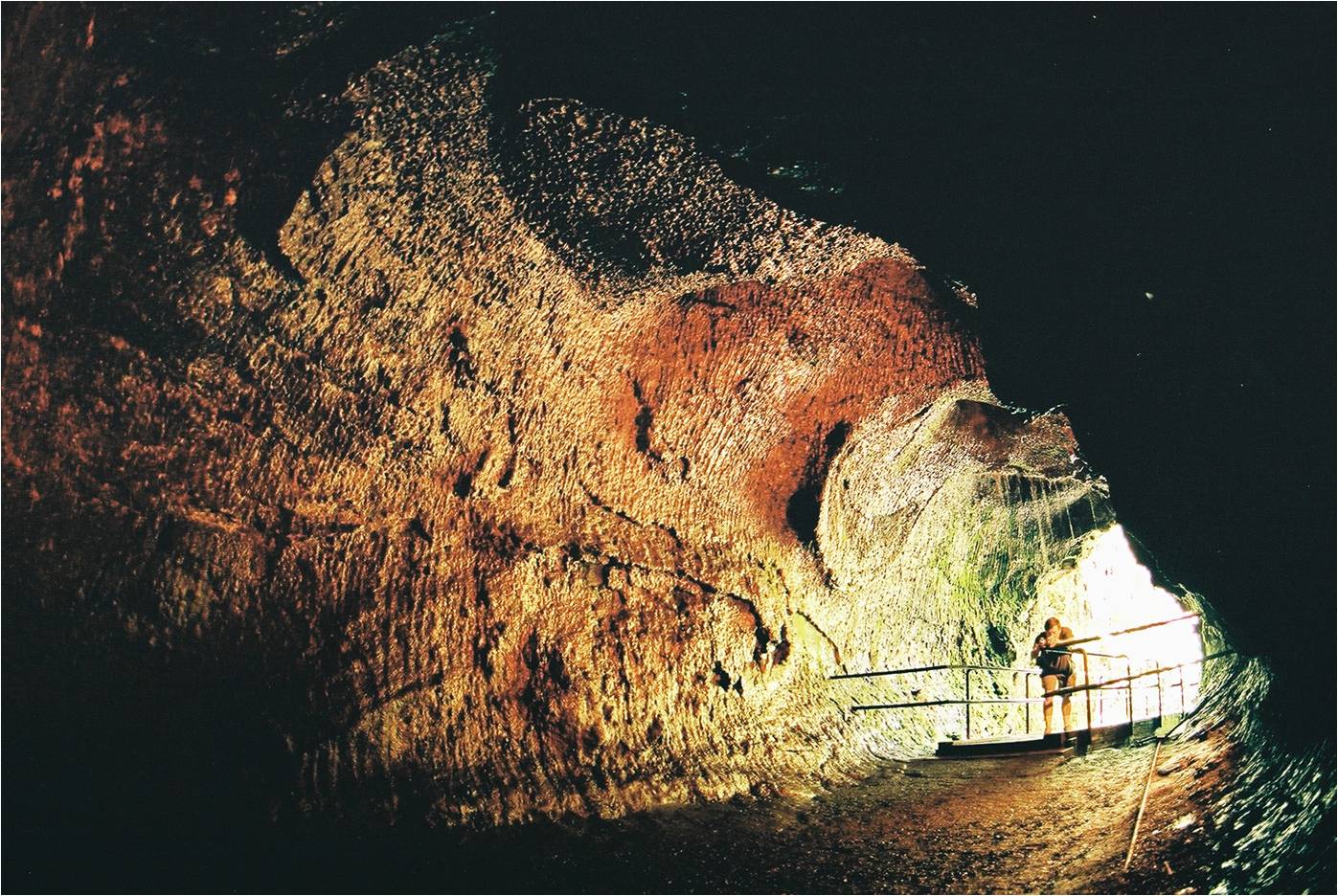
Four: Thurston Lava Tube, Volcanoes National Park, Hawai'i.
This is where we exited the lava tube, a cavelike underground channel through which lava once flowed, but hollowed when the lave drained out.

It was a long exposure using a fisheye lens, and I'm impressed by the dynamic range captured. The textures on the walls of the lava tube are also really something. At first I did not like the idea of the man standing there, fiddling with his camera. But he stood still long enough to actually become an asset to the photograph, providing a sense of scale as Mun Siong did in this shot.


Five: Kīlauea Iki Crater
Another fisheye shot, this time with the scorching afternoon sun in the frame, and Tawin in the foreground for good measure.

Amazing dynamic range! The sun maintains its brilliance without burning out the sky for the foreground, or over-darkening the foreground for the sky.


Six: Ben, Experimental Theatre, University of Malaya.
This picture was shot by Adrian with the 11-16mm lens on the day of my Convocation.

I like the beautifully saturated sky and pink balloon, and the angle gives this creeper-covered face of the ET a sense of grandeur. Lens shot at 16mm to keep vignetting to a minimum.


Seven: Ruth Vinoth, PJ Gospel Hall.
Picture taken during the annual PKV Convo Dinner, before the event proper began.

A simple, straightforward shot, but given that the room was fluorescent-lit, the film did an impeccable job of retaining good skin tones, warm copper on the drum set in the background, and dark red/maroon on the keyboard 'cover cloth' (on top of the piano).


Eight: Jia Hui, KL Old Railway Station.
Taken the morning we left for Ipoh, while waiting for the new KTM Electric Train. The colours might bring some 'old school' thoughts to mind.

The fluorescent light rendered somewhat greenish in this shot, but Jia Hui's skin tones are intact. One of the things I like about film (and I mentioned it in this post) is that ambient fluorescent light actually causes skin tones to stand out. When digital warms colours, it warms everything flatly.


Nine: Sleepers, Electric Train to Ipoh.
Divya and Ruth asleep as the train passed a smoking factory in the distance.

Again, another seemingly normal shot, but the luminance outside the window was signifcantly higher than the luminance in the train. Digital would have been able to balance out the light with some careful metering, but the film pulled it off effortlessly; you can never quite overexpose print film.


And now for some comparison.


Tim and I went shooting in Bagan Lalang to gather material for the Dare to Dream Challenge. He was armed with Velvia, and I, with Portra.


Father and boys, shot on Velvia 50. Note the insane blues.


Ten: Father and boys, Bagan Lalang.
The same scene, same time, but different film.

Much better skin tones, but not nearly quite as evocative as the Velvia shot. Different films for different purposes, while digital almost always looks the same.


Eleven: Leanne with bouquet and koala, Sunway Convention Centre.
Di Kor and Cassandra decked the koala in felt mortarboard, gown and matching turquoise hood.

She was my fourth official convocation subject, after Yen, Mich and Mel Phoon. While I employed BW alongside digital for my previous shoots, I decided to try Portra this time around for the family portraits (using digital for the snapshots with coursemates and friends). The results were nothing short of elegant.


Twelve: Pik Tze and Leanne, Sunway Convention Centre.
They'd just met, but trust bubbly Pik Tze to ask, and pose, for a shot with a complete stranger!

Again, I think the film did a great job on the skin tones, while giving the bounced flash a muted effect. Bounced flash on digital usually looks punchier.


* * *


In summary, I think the word that best describes Portra, is 'graceful'. While Velvia is loud and ostentatious, and Astia melancholic, Portra imparts a dignified humanity to its subjects.

Photographers are wont to stereotype films (e.g., Velvia is the 'nature' film and Astia is the 'portrait' film); even Ken Rockwell says Kodachrome is horrible for people shots due to a 'greenish cast'. In spite of this, Steve McCurry shot some of his greatest portraits on Kodachrome and I've shot some of my favourite landscapes on Astia.

So I wouldn't be too quick to pin Portra down as a 'portrait' film, as can be evidenced by its effectiveness even for landscapes. Instead, I would say that Portra is a very versatile film, and that if you were stuck with only one film for a diverse range of subjects/applications, this would probably be your best bet. If you shoot nothing but nature, Velvia may suit you; but if you anticipate a variety of subject matter and lighting conditions, such as when travelling, print films are usually more flexible than their slide relatives, and Portra is among the best print films available today.


It should be noted that Portra 160 seems best exposed at ISO 100 or 125, which means it is not a film for low light. For best effects, reserve it for the warm light of early morning and late afternoon, or use flash. Alternatively, shoot Portra 400 or 800; I've not tried them, but they should be as consistent in character as 160, if only slightly grainier.

It has been refreshing shooting at around ISO 100, being so used to digital's minimum of 200 and relatively clean 800. Shooting film has made me think more about light; we've really been spoilt by digital's high ISOs that we are often content shooting in poor light just because we can get away with it.

More information on the 160VC Portra film I shoot, here.


(Review on Kodak Ektar 100 forthcoming; I need more material!)

Wednesday, November 24, 2010

Tanah Rata


I create my own luck; I could not wait
For God to speak to me
So I started talking to Him, instead.

Do not be anxious over what you will eat or what you will drink
(There is coffee in a cup.)
Sufficient for the day is its own trouble.


Order is asleep, and chaos
Is on the scaffolding;
The words of the song echo,
"Love is blindness, and cold steel
Fingers too numb to feel."


Come and have breakfast, he says;
Throw your nets over the other side.
Take it not too literally;
Though you may not be ready, imagine the Word of God alive--
Imagine what it could be.


O, ridiculous Christians—-
You who stand upon your heads
Tossing balloons and passing bread
With body parts;
But people are watching
And some of them with open hearts.


If I had more faith
I might be undefeated;
My pen and pencil, my sword and weapon--
Teach me to make my writing count.
Give us this day our daily bread,
Walk with us where we may tread
That we may go on trying.


We were saved while strangers,
But God was no stranger to man;
And so the Almighty born in a manger
Was all part of the plan,
That while we were not ready (and while we still may not be)
Before we dreamt of talking
God was speaking to you and me.


* * *


Fujichrome Astia and Kodak Tri-X.

PKV T.H.E. Camp, 30 Oct - 2 Nov 2010, Highlands Christian Centre, Cameron Highlands.

Saturday, November 13, 2010

Morning thoughts

I had a certain pang of paranoia this morning.

Having not heard for over a week from the guy who usually processes my black-and-white negatives, I panicked for a bit, thinking that he might have run away with my colour negatives. Not that they'd be of any value to him, but such was how I felt for a brief few seconds.

I thought to myself, perhaps the whole operation is a scam. After all, it's not some large established studio or company; it's just based in his house. But given the state of the world and how 'established' and 'stable' corporations are tanking, I'd put my money on the nondescript people who are making a difference.

For all that he has done for me, all that he has provided, if this is a scam, count me in with the scammers.

And then the thought came: what if Jesus was/is not who He claimed to be? Well, if this low-key carpenter from the countryside was a lie all along, then for all that He did and the lives He changed, I'd put my money and my hopes and my dreams with Him.

If Jesus is a lie, I don't know what truth is.


* * *


Welcome home, Nasha.

Barely an hour on Malaysian soil and already so much drama; can't imagine what lies ahead in the weeks to come!

Wednesday, November 10, 2010

Today Observed


Cleaner.


"God light" (copyright Ken Rockwell).

I can barely imagine what this would've looked like on slide film.


Morning flare.


The Argus Pheasant is the largest bird in Malaysian rainforests;
often heard but seldom seen, it has been said.

(I don't know what this 'argus' was about.)


He looked back.

(Soft light on face due to shooting through netting.)

Saturday, November 06, 2010

God going ahead

"But then I think and I know that unless God goes ahead of me like He did with the Israelites in olden times with the pillar of cloud by day and the pillar fire by night leading them through the desert, I am not going anywhere.

I want to see the seas split open."


-- Rachel Choong, 2 November 2009

Friday, November 05, 2010

George at 22


Kerosene lamp, turpentine flame;
Growing older, yet staying the same.

Blessed 22nd, George!

Tuesday, October 26, 2010

Am I such a masochist

That I consider choosing the path I do not want?

Maybe this is my suicide.

Saturday, October 23, 2010

10:23 on October 23


O LORD, I know the way of man is not in himself;
It is not in man who walks to direct his own steps.

-- Jeremiah 10:23 (NKJV) --


* * *


Blessed 21st, Nasha!


May our Lord continue to direct your steps as you scale greater heights and face the challenges ahead, both in and out of campus.

Monday, October 18, 2010

Dare to Dream!


Photo by Timothy Cheng, Bagan Lalang, Sept 2010.

Fujichrome Velvia 50. Nikon F80 with 50mm f/1.8 lens.


Early on in the preparation for the competition, Nasha said (on 22 Sept),

"Why don't we do something on how nature used to be our playground when we were young, but nowadays kids have artificial playgrounds and man made entertainment. I remember nature being a very strong memory of my childhood... [The competition] emphasizes quite a bit on green tech and eco products, so maybe we can find a way to work that in as well."

After a relatively failed attempt in Brickfields, we finally nailed it in Bagan Lalang, though I don't think we quite managed to connect any of it to 'green tech' and 'eco products'. Truth be told, I don't think much of those labels anyway. These children are playing in the natural environment; 'toys' don't get any greener than this!


While we were hiking up Sungai Chiling, Tim remarked, "What the mind does not know, the eye does not see," in describing the difference between someone who looks out for insects and other animals along the path that may appear hidden or invisible to someone who does not know they even exist.

I suppose that's what journalism is all about: picking out details in the messy fabric of our lives and the lives of those around us, and weaving those details into a persuasive narrative. All in all it was a great experience, and the whole process of putting everything together reminded me of T.S. Eliot's words in 'Little Gidding';

... And every phrase
And sentence that is right (where every word is at home,
Taking its place to support the others,
The word neither diffident nor ostentatious,
An easy commerce of the old and the new,
The common word exact without vulgarity,
The formal word precise but not pedantic,
The complete consort dancing together)


The team with judges Nelson Lin of the China Press, Janet Tee of the National Textile Museum and chief judge Raja Fuziah of the World Crafts Council Asia Pacific. We did not meet judges Wairah Marzuki of the National Art Gallery and Kenneth Lee of Philips Malaysia.


Our film portfolio totally smoked not only the competition from without, but also the competition from within, i.e. our other entries.

It was worth renting the fisheye at RM200+ for the week on the Big Island. It was worth buying both the N80 (RM165) and the F80 (RM330), as well as the 18-35mm (RM1150) and last year's 70-210mm (RM600). The total cost of all this gear would just about get you a D90 today, without any lenses.

As we joked, perhaps the D40+D50 was a better combination than the D90. *wink*

But Tim is right about one thing: film really makes you a lot more careful when shooting, and so you only shoot the winners. With this portfolio, we really did. We made a point about the relevance and enduring power of film in this digital age.

I guess Ken Rockwell is right: it is better to get everything right in the shot, than to dick around with stuff like HDR and other forms of post-processing.


* * *


And so we made a point, got our pictures and message out there for the public to see and hear. And we fattened our bank accounts along the way, heh.

A great campaign and, especially for Tim, a holiday well-spent I'd say.

Many thanks to Dr Zeeda for supporting us, and Dr Aziz for letting me know about the competition.

To Tim, Nasha, Yen, Fit and Ruth, congrats to all again!

Monday, October 11, 2010

October Babies

October is an awesome birthday month; possibly the second-most awesome in the year.


1st, 1972: Sivin


1st, 1988: Fitrah


4th, 1985: Joy


13th, 1959: Mum


16th, 2001: George the Dachshund


23rd, 1989: Nasha


25th, 1985: Titus


29th, 1988: George the Malayalee

Sunday, October 10, 2010

On Learning: Digital vs Film

I have often heard it said that digital is a better medium, compared to film, by which to learn and train oneself in photography. One can experiment and make mistakes at a lower cost compared to film. While I heartily agree that digital is the best medium to experiment (e.g. with long exposures and other arty stuff), I cannot agree that making mistakes at a lower cost actually helps a person improve his or her photographic skills.

While the cost of a failed shot is undeniably more expensive in film, each of those failed shots teaches the photographer important lessons which are less easily forgotten than digital mistakes. While the digital photographer more often than not just deletes the bad shot, the film photographer is permanently stuck with that bad apple staring back from the negative.

I suppose I speak partly from experience. I've been shooting digital since 2006, but film only since 2009. In the one year of shooting film, my photography gained a sense of focus (no pun intended), purpose and direction it never had in the three years of pure digital.

Maybe I had actually developed those skills in digital, and film just brought me to a higher level; that is, maybe a newcomer should begin with digital, some may say.

But consider this: digital cameras cost more than film cameras. A complete film set may cost about RM500 on the second-hand market, whereas the cheapest DSLR is about RM1800. By the time a budding photographer has shot RM1300 worth of film, he or she would've developed indispensable skills practically unknown to the newbie who blew RM1800 on the DSLR.

I am here assuming, of course, that the photographer in question would eventually explore both film and digital, and I am suggesting that it is probably a better idea to begin with film, then move on to digital, instead of vice versa. Again, this is only if one is pursuing photography for its own sake; if the camera's main function is merely to record events and serve a family or a bunch of friends, then digital is of course the more practical workhorse.

Saturday, October 09, 2010

If I could be...


Naked.

Sunday, October 03, 2010

Photography Today

Has become, in so many ways, democratised. I remember film point-and-shoot cameras being very popular up until 2003 or so. The next couple of years saw a surge in digital cameras (then called 'digicams') amongst the general public. Today, we simply call them 'cameras' and their film predecessors have more or less been relegated to history.

Lately, the trend in Digital SLR (DSLR) acquisition is nothing short of alarming. Around almost every corner in any given public space or shopping mall, are people with DSLRs hanging around their necks. Whether this is because the masses have suddenly discovered a passion for photography, or because DSLRs are a lot more affordable these days, or simply because it's 'cool' to carry/own a 'high-end' camera, I don't really know. It's probably a mix of all three, plus the fact that many compact cameras have gotten pretty ridiculous with features that are really not integral to photography.

When I started out with my DSLR in 2006, the cheapest models retailed for about RM2700 or so. Today, that money can fetch very decent cameras like the Nikon D90, and most entry level cameras fall into the under-RM2000 bracket.


As the DSLR market becomes saturated, especially with more DSLR-as-accessory users than actual photography enthusiasts, I have over the last year or so forced myself to consider what photography really means to me, and how I can distinguish myself from the hordes of trigger-happy enthusiasts. Someone once said that unique images are made when one points the camera away from where everyone else is pointing theirs, or something to that effect. For me, that 'somewhere else' was film, and the journey has been a very rewarding one so far.

Mr Tomohisa Ikeno, designer of Nikon's flagship film SLR, the F6, said:

I think the essence of [film's] appeal can be summed up as "the value of unique pictures." With a digital camera, the number of pictures you can take is infinite, in the sense that there is no limit in the number of shots to take, unlike shooting with film. Some photographers reject the prospect of such ease, as they desire a more careful, rigorous approach to taking pictures. They want to treasure each picture-taking opportunity by etching their vision on film.


Over the last few weeks and months, I've seen a sudden profusion of DSLR owners; among them, Noel and his D40, Melody and her D3000, Adelene and her D90, Suzanne and her 550D, Louise and her 550D, and Lee Fui and her Lumix G1 (which is not an SLR, but an interchangeable-lens camera nonetheless).

Talking to Suzanne at Len Yi's housewarming, I thought about the days of film, when high ISOs were unheard of. When there was no such thing as Image Stabilization or Vibration Reduction. When pictures could not be previewed and the photographer was limited to 36 exposures of the same ISO at any one time. And, if you go further, when autofocus did not exist (let alone today's insane 39-point or 51-point DSLRs), and when burst mode was a figment of the imagination.

With all those limitations, the photographers of the past produced some really legendary images. If there is one reason why I still find photography exciting, it's because I know I'm not there yet. There is still so much to learn, and so much to accomplish.


A friend recently shared,

Now that there are DSLR toting folks everywhere, I think it's good for you to venture deeper [...] You could dabble with more conceptual and challenging photography. I think it's attention to things like sense of place that set apart the truly great photographers who produce the photographs that really stick around as classic, from all the rest who can take a pretty picture and...that's it, a pretty picture.

It's a challenge I joyfully accept. I think, like Jia Hui, photography does keep me alive and help me stay sane in certain ways.

Emily at Tennis

Em, at the ready.

Em, focus.

Em, service.

Em, after the game. They won 9-7!

Shannon, UM's veteran player.


* * *


I never knew tennis could be this engaging.

SUKMUM, 11th College, 2 October 2010